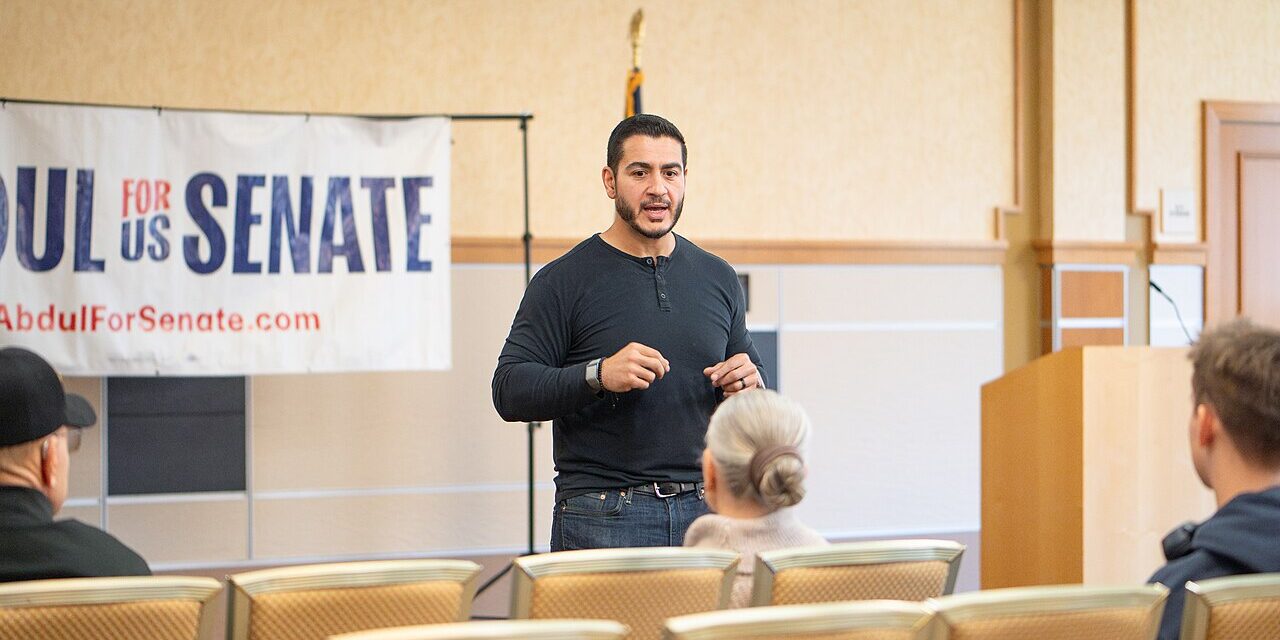
Photo: El-Sayed at Michigan Technological University, October 22, 2025 (Conlan Houston, CC BY-SA 4.0, via Wikimedia Commons). Image via Clarity with Michael Oren.
Opinion
The Meaning of Michigan
It is in Michigan—improbably but plausibly—that the future of American Jewry will be decided.
Michael Oren · November 2, 2026
Contrary to the iconic Saul Steinberg map, published on The New Yorker’s cover in 1976, America does not end at the Hudson River. “In fact,” Prime Minister Netanyahu once told me, “America begins seventy miles west of New York and ends seventy miles east of Los Angeles.” And in the middle of that vast expanse sits the verdant, generally prosperous, and usually stable state of Michigan. “That’s why I wish again that I was in Michigan,” wrote the great American Jewish composer Irving Berlin back in 1914. One wonders if today, 112 years later, Berlin would express the same yearning. For it is in Michigan—improbably but plausibly—that the future of American Jewry will be decided.
It’s in Michigan that an amply documented antisemite may be elected to the U.S. Senate.
On paper, Abdul El-Sayed is the fulfillment of the American dream. Educated at Michigan, Columbia, and Oxford, a former Rhodes Scholar with both an MD and a Ph.D., director of major Michigan health departments, charismatic and articulate—at forty-two, he seems bound for national prominence. But El-Sayed, a protégée of Bernie Sanders and other far-left Progressives, has espoused many of the positions familiar to followers of New York Mayor Zohran Mamdani and members of the Democratic Socialists of America. And born to Egyptian immigrant parents, El-Sayed was raised on a hatred of Israel so visceral it easily melds into antisemitism.
Though far from the first Democratic politician to call for the cessation of U.S. military aid to Israel or to accuse it of apartheid and genocide, El-Sayed is the first candidate for national office to justify an attempted mass murder of Jews. On March 12 of this year, Lebanese-American Ayman Mohamad Ghazali drove a fuel-and fireworks-laden pickup truck into Temple Israel outside of Detroit. The synagogue at the time was crowded with children and teachers. Fortunately, the truck became wedged in a hallway and Ghazali shot himself before the cargo could explode. But rather than express relief for the many innocent lives saved or unequivocally condemn a flagrantly racist act of terrorism, El-Sayed noted that Ghazali had lost close family members in Israel’s battle with Hezbollah in Lebanon. “Hurt people hurt people,” the aspiring senator explained.
More recently, a campaign ad released by a pro-El-Sayed PAC shows a working-class couple unable to buy eggs and bananas for their children. The mother says, “We have to set that $7 aside for killing Palestinians.” The commercial not only accuses Israel of genocide but of taking billions out of Americans’ pockets to pay for its universal healthcare. ADL chief Jonathan Greenblatt described the clip as “a case study in antisemitism,” but not El-Sayed, who repeatedly refused to condemn it.
El-Sayed has since tried to walk back his comments about the Temple Israel attack and tried to disassociate himself from the antisemitic ad. He insists that he’s not Michigan’s Mamdani or a secret member of DSA. He similarly distances himself from his family’s longstanding connections to the terrorist Muslim Brotherhood, denounces antisemitism, and proclaims his commitment to protecting the state’s 129,000 Jews. But no one doubts—nor does he deny—that his hatred of the homeland of half of the world’s Jews and sympathy for those sworn to destroy it remain undiminished. “The ad did not invent its argument,” said El-Sayed’s former Democratic challenger Representative Haley Stevens. “It dramatized one Dr. El-Sayed has made in his own words throughout this campaign: that Israel is the reason Michigan cannot afford schools, healthcare, and child care.” Stevens has since endorsed Republican candidate Mike Rogers.
She is scarcely alone. No one doubts that, if elected, El-Sayed would not only vote against further military aid to Israel but also against systems development and intelligence sharing with Israel. He would favor boycotts and sanctions. No one doubts that El-Sayed’s election would sound not a dog whistle but a clarion call to Jew-haters nationwide.
For American Jews, El-Sayed’s victory may well be a turning point from which there is no return.
Which brings me back to Michigan—not the land of the farms and streams longed for in the Berlin ballad, but the state that epitomizes Midwestern America, a down-to-earth land of basically clearsighted and tolerant people who have been traditionally welcoming to Jews. Michigan is not New York, a politically raucous city filled with the disgruntled and indebted humanities majors who are just maddened enough to elect a Mamdani and other DSA fanatics. Michigan is a bellwether, a standard-bearer, for much of America. For American Jews, El-Sayed’s victory may well be a turning point from which there is no return. Jew-hatred will have officially come to the senate.
This article was originally published on Clarity with Michael Oren.