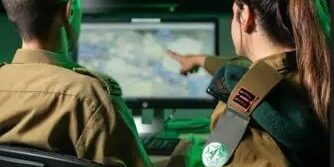
Photo: Israel’s Military Intelligence Directorate (IDF). Image via Clarity with Michael Oren.
Opinion
The Price of Intelligence
Even if those who betrayed their country and fellow soldiers in NAZA are brought to justice, the environment that spawned their crime, that fostered and nurtured it, will remain intact.
Michael Oren · October 15, 2026
Israeli leaders across the political spectrum have called for identifying and trying for treason the twenty-four intelligence officers who anonymously accused Israel of war crimes and genocide in the award-winning film, NAZA. Unquestionably, those officers deserve to be evicted from the IDF and perhaps even jailed for violating the army’s secrecy laws and the terms of their highly classified service. Their claim to have personally approved airstrikes that killed as many as 500 Palestinian civilians was patently false. At no time did anybody in 8200 sanction an airstrike. Such approvals were made solely by a select group of senior air force officers who drew on multiple sources, above all reports from soldiers in the field. 8200 estimates were merely one of those sources, and rarely the decisive one. And no Israeli airstrike killed 500 civilians or remotely close to that.
By accusing Israel of deliberately and savagely killing massive numbers of Palestinian civilians in Gaza, these faceless officers inflicted immense damage on our state and reinforced the charges of war crimes and genocide currently being leveled against us. They committed a gross injustice to the hundreds of pilots, analysts, and lawyers who worked tirelessly to limit civilian casualties. Millions of text messages and leaflets were distributed warning Palestinians of impending airstrikes, many of which were aborted for fear of harming too many civilians. No less libeled by NAZA were the tens of thousands of IDF soldiers who daily risked injury and death to avoid harming the civilians used as human shields by Hamas.
Yet, even if those who betrayed their country and fellow soldiers in this film are brought to justice, the environment that spawned their crime, that fostered and nurtured it, will remain intact and is likely to produce similar traitors in the future. That environment is the one from which most, if not all, of those interviewed purposely serve—the elite intelligence unit 8200.
In my book, 2048: The Rejuvenated State, published before the war, I surveyed the major challenges Israel must overcome before its 100th birthday. Along with the sovereignty issues in the Haredi and Bedouin communities, foreign relations and defense policy, I highlighted the problem of 8200.
8200 is the equivalent of America’s National Security Agency, and like the NSA, it is one of the largest and most sophisticated intelligence units in the world. In many ways, 8200 is the pride of the IDF, contributing immensely to the country’s defense. Numerous operations owe their success, partially or in full, to the prowess of 8200. But, along with its outstanding role in safeguarding Israel, 8200 also perpetuates and deepens the nation’s social gap, which is one of the world’s widest.
8200 does this by drawing its ranks overwhelmingly from the highest socio-economic segments of the population, from the affluent neighborhoods of north Tel Aviv and Haifa, which offer the finest public education and private tutors. While in the unit, the soldiers are actively recruited by Microsoft, Amazon, and other high-tech companies that promise them lucrative packages once their service is complete. Those soldiers go on to earn salaries well above the Israeli national average, to establish cutting-edge start-ups, and to make exits worth millions and even billions. By contrast, our infantry and armored brigades are frequently drawn from less privileged communities, often in the periphery. No high-tech company is recruiting from Golani and the 7th Brigade. The soldiers finishing their service there begin their adult lives without any of 8200’s advantages.
Some years ago, I was shocked to hear a radio commercial in which one Jewish mother brags to another that her son has just been accepted to the Navy captain’s course. “You think that’s impressive,” the other Jewish mother replies, “my son got accepted to 8200.” The second Jewish mother has every reason to celebrate. Her son would be guaranteed a high-class income. Her son would never have to risk his life in battle. The commercial was for private programming classes for teenagers.
Beyond its profound socio-economic impact, service in 8200 has a powerful political and even strategic impact. “Almost everyone I serve with supports the men who interviewed for NAZA,” a young 8200 officer recently told me. And when I asked him why that was, his answer was simple: “They all come from the same upper-class Tel Aviv neighborhoods, even the religious officers. They never have to carry a gun and they’re all predictably left wing.” The young officer was not the least surprised by those who interviewed for NAZA. “More will follow,” he predicted.
Must the price of 8200’s excellence be the widening of Israel’s social gap and the risk of betrayal by some of its officers?
Must the price of 8200’s excellence be the widening of Israel’s social gap and the risk of betrayal by some of its officers? It’s a hard question, but one that must be asked. The time has come to take a hard look inside the unit and explore how its ranks can be diversified without impairing its performance. At the same time, the army must develop ways in which the soldiers who fought hundreds of days in Gaza and Lebanon have the same advantages as those who served in Herzliya. The faceless traitors filmed in NAZA must be brought to justice but so, too, must justice be done to the soldiers—combat and non-combat alike—who serve their country loyally and selflessly.
This article was originally published on Clarity with Michael Oren on Substack.