Fighting NAZA like Jenin, Jenin
Previous libel against Israel, Macklemore’s performance, and the current controversy surrounding the newly released documentary, “NAZA.”
In 2003, actor Mohammad Bakri, a favorite of the Israeli and international entertainment industry with ten movies to his credit, produced an award-winning documentary called Jenin, Jenin. Based exclusively on his interviews with Palestinian residents of Jenin, the film accused IDF troops of massacring hundreds of innocent civilians in the city during the previous year’s Operation Defensive Shield. Premiered at Tel Aviv’s cinematheque, Jenin, Jenin, immediately sparked outrage. Twenty-three Israeli soldiers were killed in the battle which, even according to the UN, resulted in the deaths of fifty-two Palestinians, the vast majority of them terrorists.
Far more recently, the tour of celebrated singer Ed Sheeran featured an opening performance by rapper Macklemore (Benjamin Haggerty) whose song “Hind’s Hall,” dedicated to the pro-Palestinian protesters at Columbia University, accused Israel of apartheid and genocide. Appearing at New Jersey’s MetLife Stadium on September 4, Macklemore sang the song and exhorted the sold-out crowd to join him in chanting “Free Palestine.” My son and daughter-in-law, both diehard Sheeran fans, had tickets to the next concert, but returned them rather than suffer through Macklemore’s hatred.
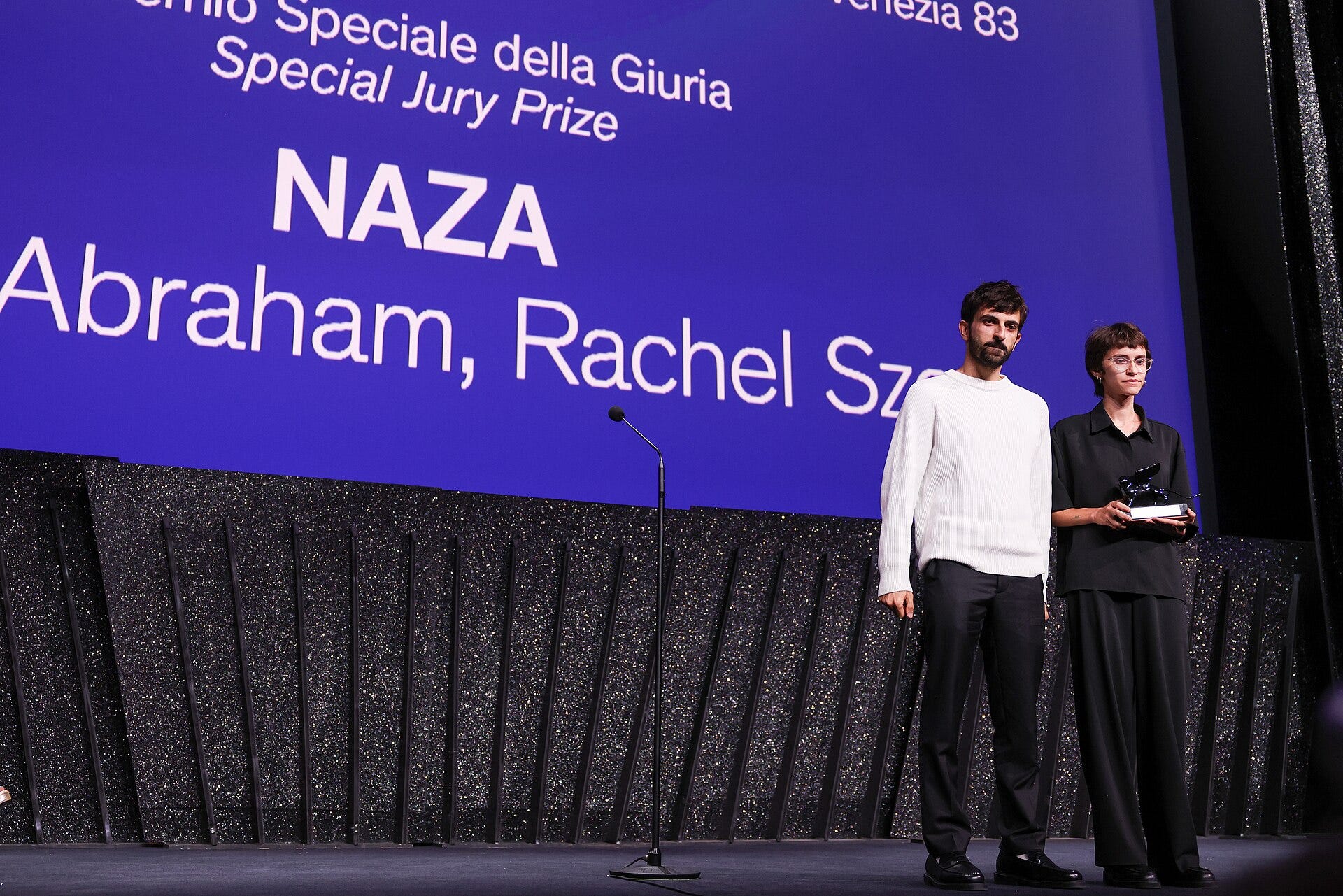
Though separated by more than a quarter-century, the two incidents—Bakri’s film and Macklemore’s performance—were evoked by the current controversy surrounding the newly released documentary, NAZA. Like Jenin, Jenin, it too, charges the IDF with committing atrocities by indiscriminately bombing civilians in Gaza. It, too, bases its accusations largely on interviews. Unlike in Jenin, Jenin, though, in NAZA—a Hebrew acronym for “Collateral Damage”—those accusing Israel of war crimes are not Palestinians but anonymous Israelis who claim to have served as intelligence officers. Unlike Bakri’s film, NAZA was made by two Israelis, Yuval Abraham and Rachel Szor. The feat of two Israeli Jews documenting their country’s genocide of myriad innocent Palestinians sufficed to earn NAZA—a name that sounds pruriently like Nazi—the special jury prize and a twenty-five-minute standing ovation at the Venice Film Festival.
Since its release, NAZA has sparked near-panic in the Israeli government. Israeli diplomats around the world have been issued orders to fight the film’s claims with all the PR means possible. Government ministers have called not only to ban the film but to rescind its filmmakers’ citizenship. As someone who has just now completed a detailed book on October 7 and Israel’s war in Gaza, I can attest with total certainty that IDF officers did their utmost to minimize civilian casualties, even at the risk of our own soldiers. No order was ever given—as NAZA alleges—to kill 500 civilians.
Yet trying to convince the world that the documentary is rife with falsehoods will hardly mitigate the damage it will inflict on Israel’s image. No one in that rarefied Venetian audience will be convinced that Israel is anything other than genocidal. No—the only effective response to NAZA is that which succeeded in silencing both Bakri and Macklemore—not by crying but by fighting back hard.
Five IDF reservists, veterans of the Jenin fighting, successfully sued Bakri for libel. Israel’s Supreme Court upheld a banning of the film in Israel and awarded damages to the plaintiffs. Robert Kraft, an outstanding Israel-supporter and owner of the Gillette Stadium in Massachusetts, led other stadium owners in threatening to cancel their Ed Sheeran concerts if Macklemore continued to perform. The result: Bakri never again appeared in an Israeli film. Macklemore was dropped from Sheeran’s concerts.
Israel must adopt a similar gloves-off approach to fighting NAZA. Veterans of the Israeli Air Force, especially those who personally approved each and every bombing raid in Gaza, and graduates of Unit 8200, must sue the filmmakers for libel. An internal investigation must be launched to reveal the identities of the supposed intelligence officers who participated in their country’s betrayal. Venues showing the film must be publicly branded for promoting antisemitism.
The government does not have the power to revoke the citizenship of Abraham and Szor, but there is no need to. The survivors of October 7, the hundreds of thousands who fought courageously and morally in Gaza, the wounded and the families of the dead, will no longer view them as part of us.