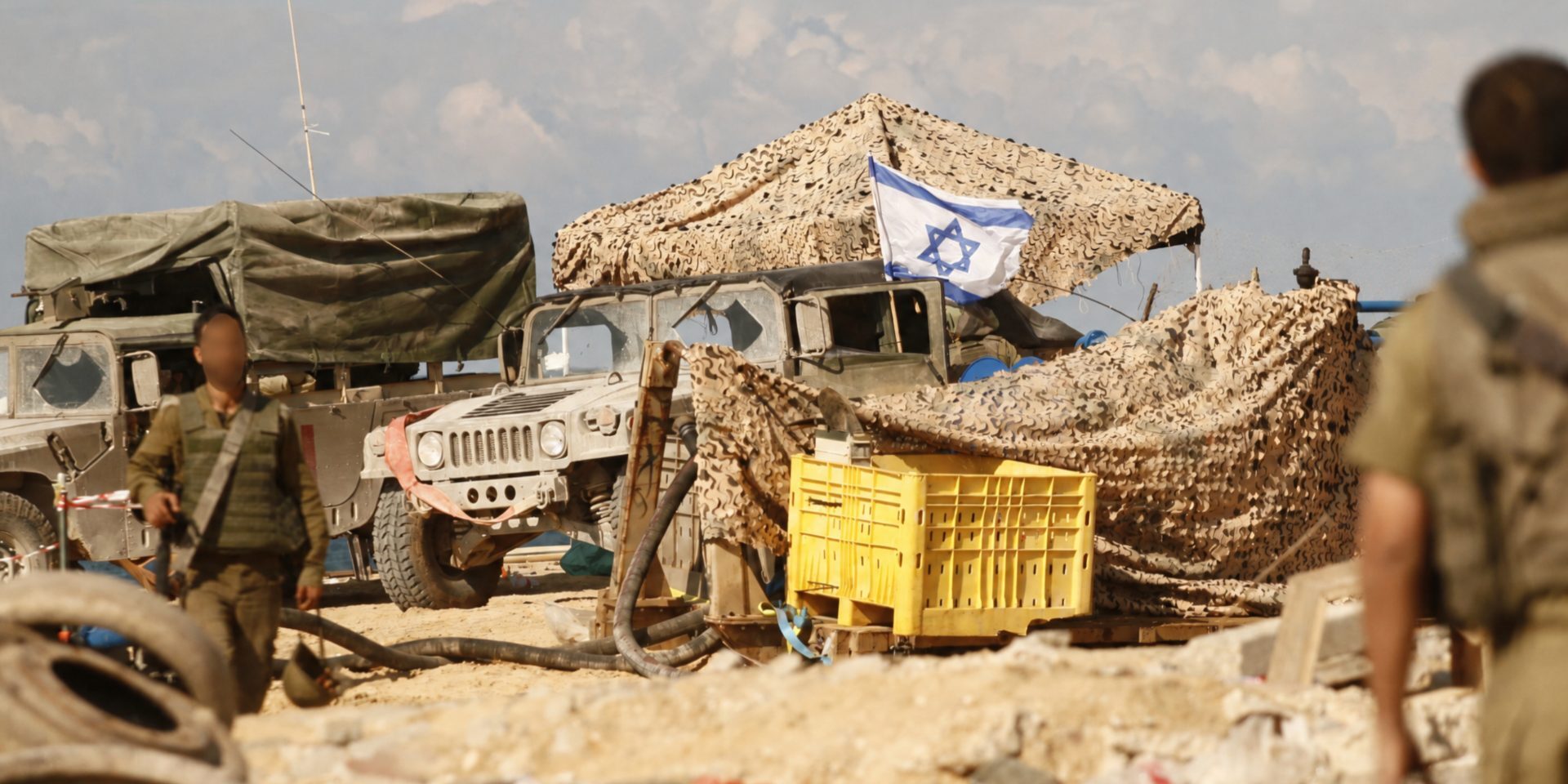
Photo: IDF in Gaza. Image via Clarity with Michael Oren.
October 7th and the Meaning of Israel’s Current Policy in Gaza
The third anniversary of the Hamas attack is a reminder of how the State of Israel has transformed since that day.
Michael Oren · October 7, 2026
“How has October 7 changed the State of Israel?” That is the most frequently asked question I get in international interviews. My answer invariably begins with the trauma and the sadness, the anger and disillusionment, but also the immense pride in our soldiers and our national resilience. I speak about the promise that Israeli society has made to itself—to never again allow massive terrorist forces to build up on our borders or to let Iran develop nuclear weapons. But for Israelis, I stress, the war that began three years ago has not ended. The great task of restoring our confidence and our deterrence power—of upholding Israel’s raison d’être—continues.
Nowhere is the war’s continuation clearer than in Gaza. Contrary to the government’s goals of destroying Hamas and achieving total victory, 47% of Gaza remains under Hamas rule. But the terrorists no longer have access to major foreign funding and arms supplies and no longer threaten our communities and cities with rocket fire. Instead, Hamas terrorists are trapped in an area in which they cannot openly maneuver or safely show their faces. Methodically, Israel has been eliminating every terrorist who took part in the October 7 attack or who held hostages thereafter.
That operation, ascribed by the media to a special security unit named NILI, is an essential stage in our recovery from October 7. The State of Israel exists to defend its land and citizens and to ensure that Jewish blood can never again be shed with impunity. Israel cannot live up to this most fundamental role as long as thousands of Palestinian terrorists remain free, armed, and mobilized. Assassinating them, one by one, not only sends a clear message to our other enemies in the region but, more importantly, a reassurance to ourselves. The State of Israel will not forget, it says, will not forgive, and will not remain passive.
The State of Israel will not forget, it says, will not forgive, and will not remain passive.
This does not mean that the policy is cost-free. In a recent conversation with a senior member of the Trump administration’s team working on Gaza, I was told that Israel is making a big mistake by not cooperating with the fifteen-point plan to disarm Hamas and begin the process of withdrawing IDF troops from the Strip. “Israel should consider the fact that both houses of Congress may not be so friendly after the midterm elections on November 3,” he said, “or the presidential election of 2028.” I replied that the vast majority of Israelis believe that Hamas, though it may go through the motions of disarming, will never truly give up its guns. That belief was reaffirmed by a young reservist who had just finished several months’ service in Gaza and who recently told me that all of his fellow soldiers, even those planning to vote for left-wing parties, are unwilling to withdraw from Gaza. “The status quo sucks,” the reservist said, “but it’s better than the alternative.”
In the coming months, Israel will have to make a choice. We can continue the policy of eliminating the Hamas terrorists who participated in October 7 and risk friction with the White House or cease the targeted assassinations and remain on good terms with Washington. Most Israelis would probably prefer preserving the present situation in Gaza to a disarmament program that cannot really be enforced. As important as it is to have strong ties with the American administration, we must view the current policy of eliminating Hamas terrorists as essential to our security, our resilience, and, moreover, to our recovery.
This article was originally published on Clarity with Michael Oren on Substack.