Will Hamas Really Give Up Its Guns?
August 4, 2026
As we learned from the recent U.S.-Iran memorandum of understanding (MOU), such documents can rapidly become memoranda of misunderstanding in the Middle East. That is likely to be the case with the U.S.-brokered agreement on Hamas’s disarmament and Israel’s withdrawal from Gaza.
“Today, the Board of Peace reached a HISTORIC agreement for the COMPLETE DISARMAMENT of Hamas and all other armed groups in Gaza,” President Donald Trump triumphantly declared on Truth Social on Thursday. The Board of Peace, presided over by Trump and including Turkey and Qatar among its members, was charged with funding and implementing the administration’s September 2025 20-point peace plan for Gaza. This provided for a permanent ceasefire and the return of all of Hamas’s Israeli hostages, living and dead. But the fulfillment of the subsequent points—Gaza reconstruction, deradicalization, and long-term efforts for peace—was contingent on Hamas disarmament.
Once it commenced, the disarmament process, including the mapping of Hamas tunnels, would set in motion a gradual Israeli military withdrawal to the so-called Yellow Line and eventually from all of Gaza. Verifiably demilitarized, Gaza would then be secured by an International Stabilization Force, composed of troops from multiple countries, and administered by Palestinian technocrats of the National Committee for the Administration of Gaza (NCAG). “This is a monumental step toward lasting PEACE and SECURITY,” Trump exulted this week, referring to Hamas’s pivotal willingness to disarm.
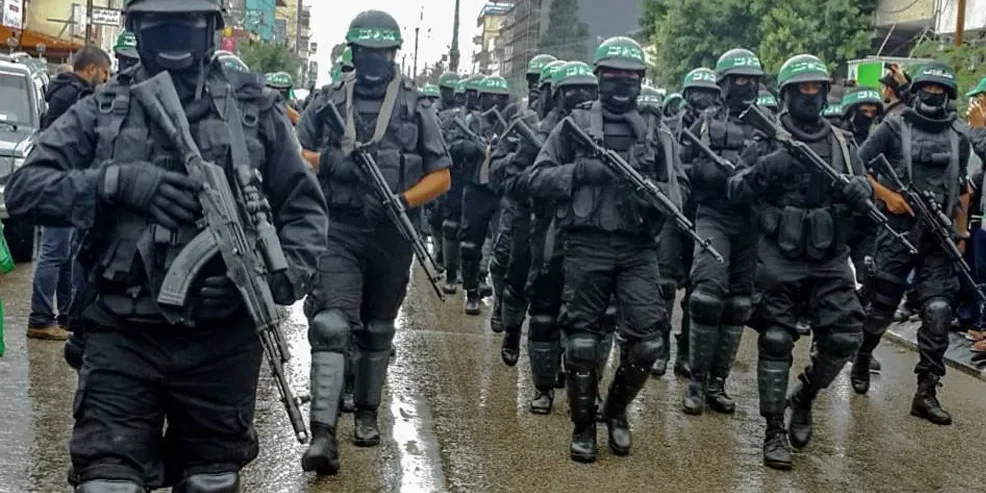
The question is: Will Hamas really give up its guns? A closer reading of the agreement reveals that Hamas will not initially turn over its weapons but only put them in NCAG storage. Further ambiguity surrounds the definition of the word “weapons”—whether it refers only to rockets and rocket-propelled grenades, as Hamas prefers, or to all small arms as well. Added to those uncertainties is the matter of reciprocity. As Hamas spokesman Ghazi Hamad insisted, “We will not take a single step [toward disarmament] unless we are certain that Israel will also carry out its commitments.”
The extent of that commitment, though, is also far from clear. Official Israeli sources have expressed reluctance to withdraw from any part of Gaza, even the 17 percent that the Israel Defense Forces occupied beyond the 53 percent demarcated by the Yellow Line, before Hamas disarms. Withdrawal before total disarmament, the Israelis reason, will result in armed Hamas elements infiltrating along and across the Yellow Line. The Israelis also demand that Hamas surrender all its arms, irrespective of their caliber. “There’s practically no heavy weapons in Gaza,” Prime Minister Benjamin Netanyahu stated in February. “There’s no artillery. There’s no tanks. There’s nothing.” The only weapons that mattered, he continued, were the 60,000 AK-47s in Hamas’s hands. “That’s how they execute people. That’s how they shoot our people. . . . They did the worst massacre of the Jewish people since the Holocaust with AK-47s.”
Hamas, paradoxically, wouldn’t disagree. While willing to turn over the Herculean task of governing Gaza to the NCAG, Hamas without its guns forfeits its basic jihadist identity. It will also render its terrorists vulnerable to the many thousands of Palestinians seeking vengeance for the loved ones they have lost since October 7.
Not surprisingly, Hamas has not agreed to turning over its entire arsenal at once but only to an amorphous “road map” to disarmament involving several stages and conditions. The Israelis, meanwhile, continue to occupy most of Gaza and to target Hamas terrorists they claim were either complicit in the October 7 attacks or actively plotting new ones. Roughly 2 million Palestinians are crammed into 30 percent of the Strip, living in either ruins or tents and dependent on humanitarian aid.
The situation is stagnant but almost certainly unsustainable. By merely signaling its willingness to disarm, Hamas has, as an unnamed Arab diplomat told The Times of Israel, “put the ball in Israel’s court.” Similarly, Board of Peace Director-General Nickolay Mladenov asserted that Israeli “withdrawal must move in lockstep with decommissioning” Hamas weapons. But the greatest pressure on Israel will likely come from Washington.
Desperate for a diplomatic win before November’s midterm elections and piqued by Israel’s objections to Turkish and Qatari involvement in Gaza, President Trump is ramping up his demands for Israeli pullbacks even before Hamas fully disarms. Indifferent to Netanyahu’s own need to demonstrate strength ahead of Israel’s fateful October 27 elections, the president said he will be “very disappointed” if Israel blocks progress on his 20-point plan. A senior administration official underlined the point, indicating that Trump will be “very, very disappointed” by Israeli intransigence.
As in the case of Iran, an MOU can be open to widely divergent interpretations and radically altered circumstances. In the Gaza Strip, no less than in the Strait of Hormuz, an MOU may lead not to peace but to further upheaval.