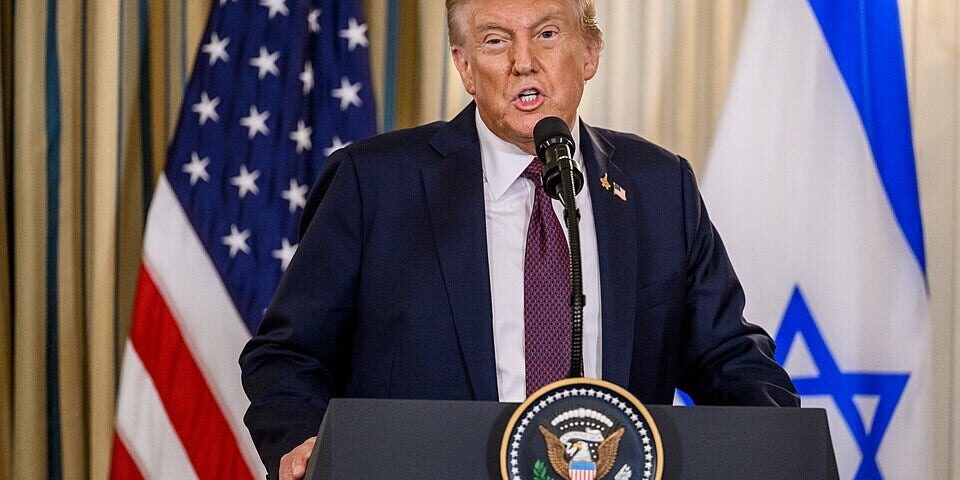
Photo: President Trump announcing the U.S. peace plan, September 29, 2025. Joyce N. Boghosian/White House. Image via Clarity with Michael Oren.
Opinion
Making the Most of Trump’s Final Two Years
With two years remaining in the Trump administration, we must ask ourselves how best to make use of the limited time we have left.
Michael Oren · November 25, 2026
On April 11, 2020, at the height of the presidential race between Joe Biden and Donald Trump, I published an article in Israel Hayom criticizing the Israeli government for failing to make full use of Donald Trump’s previous four years in office. To be sure, Trump had recognized Jerusalem as our capital and our sovereignty over the Golan Heights, cut funding to UNRWA, and withdrawn from the nuclear agreement with Iran. But could he have done more?
“Should Trump win re-election,” I wrote, “Israel would be wise to not once again squander an excellent opportunity to ‘take care of’ Hamas and Hezbollah, and possibly even Iran, while Israel has Washington’s military, political and legal support”
Trump did not win that election, and when Israel went to war with Hamas, Hezbollah, and Iran, it received support from President Biden that was less than unequivocal. Now, with two years remaining in the Trump administration, we must ask ourselves how best to make use of the limited time we have left.
Israel’s first priority must be to eliminate the Iranian threat, foremost among its dangers the nuclear program, and ideally to bring down the regime itself. Unfortunately, the prospects of achieving this, even with a renewed military campaign, remain uncertain. The same is true of the possibility of truly uprooting Hamas and Hezbollah, particularly if the Iranian regime survives. What we can reasonably achieve is diplomatic and military backing for Israeli operations to prevent Iran from producing nuclear weapons and prevent its terrorist proxies from regrouping, rearming, and rebuilding their infrastructure. The IDF can continue eliminating Hamas operatives who participated in the October 7 massacre.
Israeli and American diplomats can continue negotiating peace agreements with Lebanon, Saudi Arabia, and other Muslim countries, while working to expand the Abraham Accords. But the success of these efforts will depend to a considerable extent on Trump’s willingness to defeat the Iranian regime.
The new Speaker of the House, Hakeem Jeffries, a moderate Democrat generally considered pro-Israel, has called for sanctions against violent settlers. A ban on all arms sales to Israel could be next. To prepare for this eventuality, Israel should use the next two years to replenish its stockpiles of essential American weapons, ammunition, and spare parts, all of which will be vital to our future defense.
In light of Jared Kushner’s recent warning that Israel will become an international pariah unless it fulfills its commitment to withdraw from Gaza as Hamas disarms, Israel must seek assurances from Trump regarding our ability to retake Gaza and destroy Hamas if it fails to disarm. We must ensure that blame for the failure of the ceasefire rests entirely on its true cause — Hamas. Withdrawal, even from part of Gaza, would be an extremely difficult move for any Israeli government, but we may have no choice if we wish to maintain a good and productive relationship with the president over the next two years.
Arguably, the most important initiative Israel can undertake in coordination with Trump concerns the peace process. Although discussing this subject remains deeply painful for Israelis in the shadow of October 7, the Palestinian question will undoubtedly be raised by the incoming Congress and perhaps by the next president as well. A two-state solution could be imposed on Israel by force. This is precisely the policy recently proposed in The New York Times by Jon Finer, Biden’s former deputy national security adviser. Israel, however, can forestall such pressure by engaging in an intimate dialogue with Trump’s team about creative ways of addressing the issue. The Trump administration’s 2020 Deal of the Century should also be revisited. Although it was a two-state plan, it required the Palestinians to democratize, renounce all ties to terrorism, and recognize Israel as a Jewish state.
Two years is not a long time in international relations, and it is even shorter in the absence of a stable Israeli government. Making the most of Trump’s twenty-four months in office is a compelling reason for leaders of all the different political parties to unite and get to work.
“Two years is not a long time in international relations, and it is even shorter in the absence of a stable Israeli government.”
This article first appeared in Israel Hayom.
This article originally appeared on Clarity with Michael Oren.