Unlike the Wise Son who acknowledges that Jewish law and Jewish life are complicated and approaches them as a Jew, the Wicked Son sets himself apart from his people and doesn’t really bother to ask.
When, last January, he was accosted by pro-Palestinian protesters who accused him of being a “genocide denier,” a “liberal Zionist mouthpiece,” and a “fascist-normalizing ruling class darling,” New York Times columnist Ezra Klein responded by attacking Israel. What the Israelis were doing in Gaza, he declared, was “destruction, apartheid, subjugation.”
More recently, after Joe Kent, President Trump’s former anti-terrorism advisor, blamed Israel and the Jews for the current war in Iran as well as the Iraq War and the U.S. intervention against ISIS, Peter Beinart praised him as a “brave man.” Similarly, Tucker Carlson is a “nice person,” according to former Israeli politician and Jewish Agency head Avraham Burg, who recently met with America’s leading antisemite.
Klein, Beinart, and Burg disagreed with their interlocutors on several crucial issues, but their reservations did not prevent them from portraying Israel as uniquely evil or from appeasing outspoken Jew haters. The three of them, therefore, share a fundamental identity. They are all Wicked Sons.
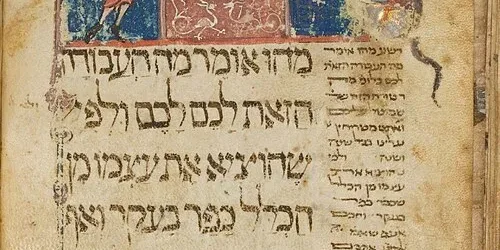
Like Satan in Milton’s Paradise Lost, the Wicked Son is the Seder’s most engaging character. “Mah ha’avodah hazot lachem?” he condescendingly asks. “What is this service to you?” The key word, of course, is “you” and not “us,” for in contrast to the Wise Son whose curiosity about Jewish tradition stems from a deep sense of belonging, the Wicked Son stands apart from his people.