Friday, February 13, 2026
“Explaining the challenges of the war to the world has been difficult”:
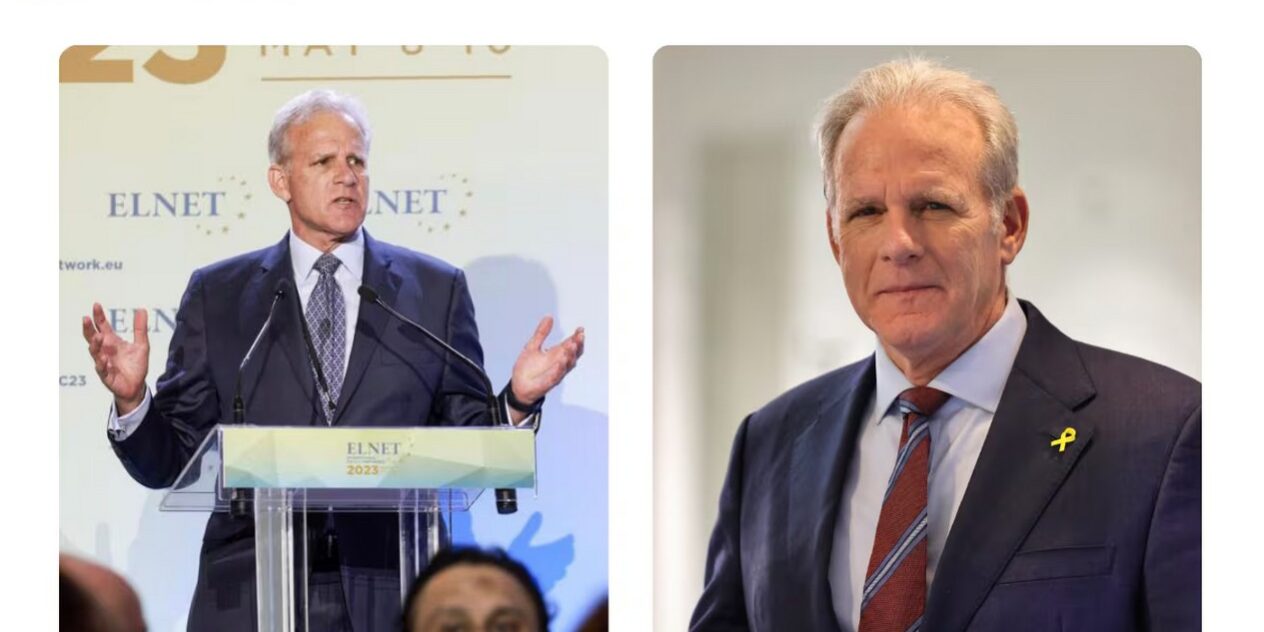
Michel Oren, former Israeli ambassador to the United States.
The diplomat spoke with SEMANA and said his country is going through a complex crisis, yet at the same time its military and civil strength has never been clearer.
By Cristian Mauricio Patiño Silva
February 13, 2026 – 5:51 a.m.
Michael Oren was born as Michael Scott Bornstein in New York in 1955.
SEMANA: What has been, for you, the most difficult moment to explain in the United States regarding the war Israel has experienced in Gaza?
MICHAEL OREN: In Gaza we have endured more than two years of a very brutal war, with many people killed. It is difficult to explain to Americans that the Israel Defense Forces had to operate on two fronts at the same time.
First, a war on the surface against 30,000 to 40,000 terrorists embedded within a population of more than two million people. At the same time, they had to fight underground, because Hamas had dug 500 kilometers of tunnels, which caused tremendous destruction.
Explaining these challenges to the world has been difficult.
SEMANA: Has Israel lost what many now call the “narrative” of this war around the world? Do you think the international community stopped listening to its security arguments?
M.O.: The answer is both. Israel has repeatedly stated that it seeks to limit civilian casualties. If you look at the figures, which are tragic, the ratio of combatants to civilians killed is approximately one to one. It is terrible that civilians die, but compared to other recent wars, such as Iraq or Afghanistan, the ratio is different.
Israel could have presented its case more effectively, but there was also a part of the world that stopped listening.
SEMANA: What was the most difficult part for you during this war?
M.O.: There were many difficult moments. One was the frustration of the world not listening. We spent entire nights giving interviews while my family, my team, and I were under rocket fire launched from Gaza, Lebanon, and Yemen.
However, the hardest part was meeting people and families who were killed on October 7 or who later died in combat. The grief and stress in society were enormous.
SEMANA: How was your relationship with Prime Minister Benjamin Netanyahu during the war? Are you still in contact with him?
M.O.: I had contact with his office and close advisers only at the beginning of the war, but I no longer advise him and now operate completely independently of the prime minister’s office.
SEMANA: Is Israel experiencing one of the greatest crises in its history, or is it still a stronger country than the world perceives?
M.O.: Both things are true. Israel is probably going through the greatest crisis in its history, but at the same time it has demonstrated immense strength.
No one thought Israel would achieve what it achieved in Gaza. Hamas today is a fraction of what it was. No one thought Israel could inflict the kind of strategic damage it inflicted on Iran last summer. So both are true: Israel is facing its worst crisis and at the same time showing probably its most impressive display of military and civil strength.
SEMANA: Is a direct clash with Iran or a prolonged war with Hamas or Hezbollah likely?
M.O.: It is the same question. If the United States succeeds in neutralizing Iran — meaning eliminating its nuclear program, its ballistic missile capability, and its support for terrorism — there would be no reason for an Israeli attack. Likewise, if this is achieved, there would be no way for proxy groups to continue attacking Israel.
SEMANA: This week, Trump and Netanyahu met. What can be expected going forward?
M.O.: Netanyahu needs clarity on what Trump’s objectives are in negotiations with Iran. If the nuclear program, ballistic missiles, and support for terrorism are not curbed, Israel will have to decide how to act.
If Trump reaches an agreement that limits the nuclear issue but not the missiles, Israel may need to act on its own and would at least seek a green light or U.S. support when Iran moves to launch its missiles.
SEMANA: Regarding Trump’s plan for Gaza, is it realistic or just a document?
M.O.: It is only realistic if Hamas is forced to give up its weapons. As long as they have weapons, there can be no reconstruction of Gaza. Nor does an international deployment to stabilize the area seem viable, because of the fear that foreign soldiers could serve as a shield for Hamas. So the key to the entire process in Gaza is disarmament.
SEMANA: Is the two-state solution — one for Israel and one for Palestine — still possible?
M.O.: I never thought it was achievable, and I believe it is even less so now. The vast majority of Palestinians do not want it, nor does the vast majority of Israelis. That is the beginning of this problem. It is a solution that neither side wants.
The solution may lie in what I call “cantons,” following the Swiss model, applied in the West Bank. There are other alternatives that could be explored, but if we insist on banging our heads against the wall trying to achieve a vision that is not viable today, it will not be helpful.
Article published in Semana magazine on February 13, 2026.
Read Article